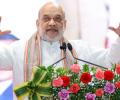
Union Home Minister Amit Shah said on Sunday that indigenously developed BrahMos missiles destroyed Pakistani air bases while its air defence system, borrowed from China, remained unused, during Operation Sindoor, which exposed its lies on terrorism to the world.

The contingent marched on the tune of CRPF song 'desh ke hum hai rakshak' played by the force band on the Kartavya Path.

Omar Abdullah states that normalisation of relations with Pakistan is difficult due to terror incidents and lack of a credible civilian partner in Islamabad.

'The background for the Saudi-Pakistan agreement is the fact that the regional security order has collapsed due to the Israeli attack on Doha.' 'The Americans have largely abandoned their security guarantee for West Asia and the region has no choice but to look at alternatives.'
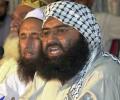
In a viral video uploaded to a YouTube channel on Tuesday, JeM commander Ilyas Kashmiri can be heard fuming over the Indian attack that killed the family members of Azhar and also bragging about fighting in neighbouring countries for Pakistan.

The Indian Army responded in a measured and effective manner to the provocation.
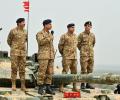
Pakistan Army Chief Asim Munir has described terrorism in Jammu and Kashmir as a 'legitimate struggle', saying his country would always stand by the people of Kashmir in their struggle.

Was Lieutenant General Ayman Bilal Safdar removed because he criticised army chief, General Asim Munir, asks Rana Banerji, who headed the Pakistan desk at RA&W.

Defence Minister Rajnath Singh said Operation Sindoor gave Pakistan a "good dose" of caution and warned against any future "misadventure" against India. He also highlighted the role of the armed forces in nation-building and the government's commitment to border infrastructure development.

After the US Supreme Court struck down President Donald Trump's global tariffs, Congress leader Rahul Gandhi accused Prime Minister Narendra Modi of being "compromised", saying his "betrayal" in the India-US interim trade deal stood exposed.

The result is a big blow to the military establishment, revealing the limits of 'political engineering'. It reflected the anger of the electorate, especially its younger voters, who have spoken decisively against the persistent harassment and victimisation of Imran Khan's political party, asserts Rana Banerji, who headed the Pakistan desk at RA&W.

The Indian Army today dismissed reports of Pakistan's military build-up along the borders, saying presence of the neighbouring country's troops seemed like routine exercises, but asserted it is always ready to tackle any eventuality.
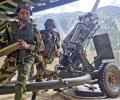
'Will this near-war, India's strongest military response so far, buy India another seven years of deterrence?' asks Shekhar Gupta.

'Pakistan does not have the capacity to fight a war with us. They do not want to fight a war. It does mischief as per its policy of 'bleed India through a thousand cuts'
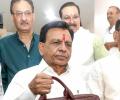
The controversy followed after another Madhya Pradesh minister, Vijay Shah, came under fire for remarks about Col Sofiya Qureshi who conducted media briefings on Operation Sindoor along with Wing Commander Vyomika Singh.

10 Heroes of the 1965 War which ended on September 23 60 years ago.
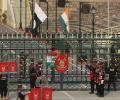
The Army further made it clear that the continuation of a break in hostilities, as decided in the DGMOs interaction of May 12, has no expiry date to it.
Pakistan on Wednesday summoned the Indian charg d'affaires and lodged a strong protest against the Indian military strikes.
Jammu and Kashmir was peaceful last night with no hostilities between the Indian and Pakistani militaries along the Line of Control and the International Border.
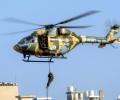
'The tools of warfare are changing. The MoD must deepen its engagement with technology thinkers that can present compelling visions of where warfare may be heading.'
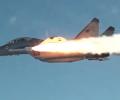
The Directors General of Military Operations of India and Pakistan firmed up the arrangement on stopping military actions on May 10 after four days of fierce offensives between the two sides that triggered fears of a wider conflict.

'Nor would it have serious implications in India's relations with Saudi Arabia that stand on their own and have improved significantly in recent times, including in defence and strategic affairs.'
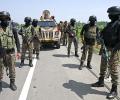
India needs to be technologically and militarily prepared to defend itself from both Pakistan and China, alerts Ramesh Menon.
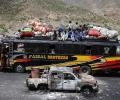
'No military offensive by Pakistan will end the insurgency in Balochistan without simultaneous, concerted efforts toward political dialogue to de-escalate tensions.'

Prime Minister Narendra Modi raised concerns about cross-border terrorism with Chinese President Xi Jinping, advocating for India-China cooperation to combat the threat. The discussion occurred during the SCO Summit amidst efforts to rebuild bilateral relations after a border standoff.

India had vehemently opposed Asian Development Bank's decision to grant $800 million loan to Pakistan saying the fund could be misused for increasing expenditure on its military, government sources said.
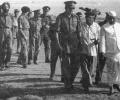
In what was perhaps the most critical meeting before full-scale war broke out, Shastri defined India's immediate war objectives to his defence minister, army, and air force chiefs: 'To defend against Pakistan's attempts to grab Kashmir by force and to make it abundantly clear that Pakistan would never be allowed to wrest Kashmir from India; To destroy the offensive power of Pakistan's armed forces...' A fascinating excerpt from Shiv Kunal Verma's must-read 1965: A Western Sunrise India's War With Pakistan.
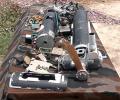
The Indian Army used Medium Machine Guns (MMGs) to target Pakistani Army forward posts along the Line of Control (LoC), inflicting heavy casualties during a ceasefire violation on the intervening night of May 7-8.

India on Thursday night swiftly foiled Pakistan's attempts to hit various key Indian installations including military stations at Jammu, Pathankot and Udhampur with drones and missiles, the defence ministry said.

Around 100 artistes heralded the parade, on the theme 'Vividata Mein Ekta (Unity in Diversity) that featured a grand presentation of musical instruments, demonstrating the nation's unity and rich cultural diversity.

Trump's new rules for how countries should treat him have led to the current breakdown in India-US relations, explains Ambassador T P Sreenivasan.

India has warned Pakistan against its unprovoked firings along the Line of Control (LoC) in Jammu and Kashmir as the directors general of military operations of the two armies spoke on the hotline amid the escalating tensions over the Pahalgam terror attack.

Pakistan is considering creating a new position of 'Commander of Defence Forces' (CDF) to improve coordination and unified command among its military services, according to media reports. The move is part of broader defence reforms and is reportedly influenced by recent conflicts and the evolving nature of modern warfare.

A female suicide bomber of the banned Balochistan Liberation Army (BLA) blew herself up at the entrance of the headquarters of a paramilitary force in Pakistan's restive Balochistan province, triggering a prolonged gunfight in which six militants were killed, security officials said on Tuesday.
Forty-two members of the United States Congress, led by Democratic Congresswoman Pramila Jayapal and Congressman Greg Casar, have written to Secretary of State Marco Rubio demanding immediate sanctions against senior Pakistani officials for what they termed an 'escalating campaign of transnational repression and worsening human rights crisis in Pakistan' under the military-backed government of Pakistan's Prime Minister Shehbaz Sharif and Chief of Army Staff General Asim Munir.

The National Investigation Agency (NIA) filed a chargesheet against seven accused in the Pahalgam terror attack case, including Pakistan-based Lashkar-e-Taiba (LeT) and its proxy The Resistance Front (TRF).
US Secretary of State Marco Rubio spoke separately with External Affairs Minister S Jaishankar and Pakistani Deputy Prime Minister and Foreign Minister Ishaq Dar, State Department Spokesperson Tammy Bruce said in a statement early Saturday.

Experts believe it would be far-fetched to believe that Riyadh would support Pakistan militarily in any conflict with India, which has robust strategic and economic relations with Saudi Arabia.

The Save Sharda Committee (SSC) in Bengaluru on Friday sought the help of the Indian government to remove the 'encroachment by the Pakistan Army' on the Sharda temple premises in Pakistan-Occupied Kashmir (POK), in order to pave way for its restoration.
